There’s been a lot of talk about cultural appropriation lately, and I’ve mostly kept out of the fray because 1. I’ve made a resolution not to fight with strangers on the internet anymore, and 2. The cultural appropriation conversation is way more context than people realize. I’ve been blessed (or cursed?) with the ability to see many sides to most arguments, and that often leaves me in the middle.
After seeing a bunch of different publications post about cultural appropriation, and seeing the mayhem that ensued in the comments section, I finally decided to jump into the conversation.
A lot of these conversations have centered around braids. With more and more celebrities began wearing braids, they’ve recently come back into the national spotlight. (But please note that they’ve always been a mainstay in Black, Latina, and Native American cultures). Usually someone on Twitter or Facebook will lament how non-black people have adopted braids, and the comments will go like this – “Well but black people don’t own braids” to “It’s a free country I can do what I want” then “Why can black people wear blonde hair but I’m racist if I have braids?” and finally “it’s just a hairstyle”.
Well see, that’s the thing. It’s not just a hairstyle. In a world that constantly forces us to assimilate to popular culture, braids, afros, and cornrows, are an act of defiance, a last stand. These hairstyles have gotten Black men and women reprimanded, suspended, or fired, simply because of their hair. Until recently, female Marines weren’t even allowed to wear locks and twists. This doesn’t happen when non-black people wear these same hairstyles. So, the issue isn’t with letting other people wear braids – it’s how the world reacts.
A black person with braids is seen as ratchet, classless, ghetto, but put that hairstyle on a white body and all of a sudden those same braids are cool, creative, high-end. This person then gets credit for “creating” this edgy new hairstyle.
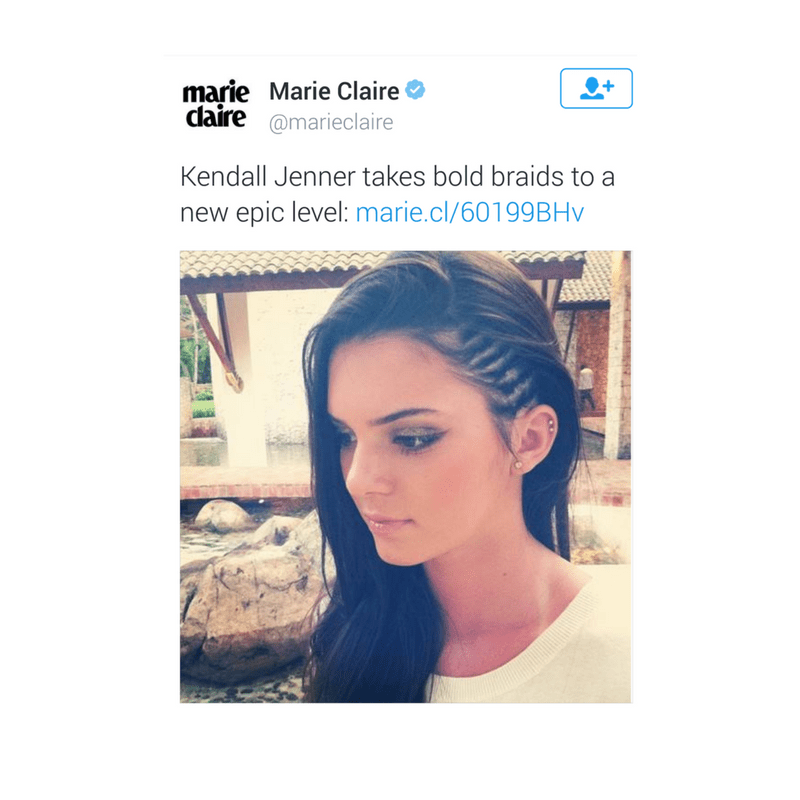
The same can go for tons of other things – saris, Native American headdresses, bindis. I remember Indian girls being made fun of for being “dot heads”, but now bindis are the hottest Coachella accessory. As an African, it’s been kind of weird to see how people have adopted dashikis after I spent my childhood being called dirty and smelly, simply because of my ethnicity.
As I stated in the beginning, the cultural appropriation conversation is way too complex to unpack in this just one blog post, think piece, or discussion. I don’t feel right saying white people can’t wear braids; it’s not my place to do so, and I absolutely recognize that not all people have bad intentions when wearing something from a different culture. I would just love for there to be more awareness. Recognize that that headdress you’re wearing means something to the culture that it comes from. Admit that your bantu knots are part of a history that is very near and dear to people of a certain heritage. One thing we can all agree on, however, is that you can’t pick and choose what parts of a culture to embrace. You can’t talk about how you hate Mexican immigrants, then turn around and paint your face like a sugar skull for Halloween. You can’t claim to love Black music and fashion, then dismiss issues facing the Black community in the same breath. This is definitely an ongoing discussion, but I’m excited to see where it goes.
For more on this subject, please check out Amandla Stenburg’s YouTube video “Don’t Cash Crop my Cornrows.”

Have any questions, observations, or complaints? Comment below.
Xoxo,
Témi
 Xoxo Témi